
How to Create a Taxi Business Plan in 2026


Starting a taxi business means making dozens of important decisions before you launch your first ride. From defining your business model and validating local demand to estimating startup costs, planning daily operations, and choosing the right technology, every decision shapes how efficiently your business will operate and how prepared it will be for growth.
This guide breaks the planning process into practical steps. You’ll learn what to include in your taxi business plan, why each section matters, and how to create a roadmap that helps you launch with confidence and make informed business decisions as you grow.
What Is a Taxi Business Plan and Why Does It Matter?
A taxi business plan is a strategic framework that helps you evaluate, organize, and document every key aspect of your future business before launch. It brings together your business model, market analysis, financial projections, operational plan, marketing strategy, and growth objectives into one structured plan. Looking at these areas together allows you to assess whether your idea is commercially viable, identify potential challenges, and understand what it will take to build a sustainable taxi business.
The process of creating a business plan is often just as valuable as the final document. It encourages you to validate your assumptions, estimate realistic startup and operating costs, assess market demand, and identify potential risks before making significant investments. It also helps you understand how different parts of the business influence one another, allowing you to make informed decisions instead of reacting to challenges as they arise.
Once your business is up and running, the same plan becomes a practical reference for tracking progress, refining your strategy, and planning future growth as your company evolves.
Define Your Taxi Business Model and Services
Before planning your finances or daily operations, you need a clear understanding of the business you’re building. Your business model defines how your company will generate revenue, who your customers are, what services you’ll provide, and how you’ll compete in the market. These decisions become the foundation for every other part of your business plan, from pricing and marketing to fleet management and future expansion.
A common mistake is trying to build a taxi company around available vehicles or technology instead of starting with the business itself. Define your operating model first, then determine the services you’ll offer and the customers you want to reach. Once those decisions are in place, it becomes much easier to plan your operations, estimate costs, and choose technology that supports your business rather than limiting it.
Choose the Right Taxi Business Model
There isn’t a single business model that works for every taxi company. The right choice depends on your target market, available budget, local competition, and long term goals. Some businesses operate a traditional taxi fleet, while others work with independent drivers, offer ride hailing services, focus on airport transfers, corporate transportation, or niche markets such as medical or school transport.
When evaluating different models, consider how each one generates revenue, what operating costs it involves, how drivers are managed, and how easily the business can scale. Choosing the right model early will make every other planning decision more straightforward.
Define Your Target Customers and Services
Your target audience should shape the services you offer, not the other way around. A company serving daily commuters will have different priorities than one focused on business travel or airport transfers. Understanding who your customers are helps you define pricing, service areas, booking options, vehicle requirements, and customer experience.
Describe exactly what you’ll offer from day one. This may include on demand rides, scheduled bookings, corporate accounts, fixed route services, airport transfers, or other transportation options. A clearly defined service offering makes it easier to position your business in the market and build a marketing strategy that attracts the right customers.
Research Your Market and Competitors
A taxi service business plan should reflect the market you’re entering, not the one you expect to find. Understanding local demand and the competitive landscape will help you validate your business model, identify opportunities, and make decisions based on real market conditions rather than assumptions.
Estimate Local Demand
Before estimating revenue or planning your fleet, confirm that your market can support another taxi service. Identify where demand comes from in your city, whether it’s daily commuters, airport transfers, tourists, corporate travel, or underserved neighborhoods. Then look at when demand peaks, how it changes throughout the week or season, and whether existing providers already meet those needs. These insights will help you estimate ride volume more accurately, prioritize the right services, and build realistic financial projections.
Analyze Your Main Competitors
Study both traditional taxi companies and ride hailing platforms already operating in your market. Compare their pricing, service coverage, booking experience, response times, customer reviews, and positioning. The goal isn’t to copy their approach, but to understand where they perform well, where customers see room for improvement, and how your business can offer a stronger value proposition from day one.
Create an Operations Plan for Your Taxi Company
A business plan isn’t complete until you’ve defined how your taxi company will operate on a daily basis. An operations plan connects your business model with the actual delivery of your service, covering everything from driver management and ride fulfillment to the technology that supports your team. Taking the time to plan these processes before launch will help you build a more efficient business and avoid costly operational issues as you grow.
Plan Your Fleet and Driver Model
One of the most important operational decisions is how you’ll build and manage your driver network. Whether you operate your own fleet, partner with independent drivers, or use a hybrid model, each approach comes with different costs, responsibilities, and growth opportunities. Think beyond the launch and define how you’ll recruit drivers, verify documents, onboard new partners, assign rides, monitor performance, and maintain service quality. Establishing these processes early creates a solid operational foundation and makes it much easier to scale your business without constantly changing the way it works.
Choose the Right Booking and Dispatch Technology
The technology you choose will influence every stage of your operation, from the moment a customer requests a ride to driver dispatching, payments, reporting, and day to day business management. Rather than focusing only on individual features, evaluate whether the system can support your business as it grows. Replacing core software after launch can be both expensive and disruptive, so it’s worth choosing a solution that will continue to meet your needs in the long term.
Mobion provides everything needed to launch and manage a modern taxi business in one ecosystem, including online booking, rider and driver apps, dispatching, payments, reporting, and administration tools. Instead of integrating multiple systems as your business expands, you can manage your operations through a single platform and focus on growing your service rather than your software stack.
Calculate Taxi Business Startup Costs
Financial planning is one of the most important parts of any business plan. Estimating taxi service business plan startup costs accurately helps you understand how much capital you’ll need, when your business is likely to become profitable, and where you should prioritize spending. Rather than relying on rough estimates, separate one time investments from recurring operating expenses to build a financial plan that’s realistic and easier to adjust as your business grows.
One Time Startup Costs
Start by calculating every expense required to launch your business. While the exact amount will depend on your business model, most taxi companies should budget for:
- Company registration, licenses, and permits
- Vehicle purchases or leasing deposits
- Insurance and legal fees
- Branding and website development
- Initial marketing activities
- Technology setup and implementation
Having a clear picture of these investments will help you determine how much funding you’ll need before accepting your first ride.
While preparing your business plan, think about how you’ll validate your assumptions before making major investments. You don’t necessarily need to commit to a full scale technology setup from the very beginning. For example, Mobion Starter allows you to test your business model in a real market, understand customer demand, and refine your operations before deciding when it’s time to scale. Instead of relying entirely on forecasts, you can use real customer and operational data to refine your financial projections, pricing strategy, and growth plan.
Monthly Operating Expenses
Once your business is running, recurring costs become even more important than your initial investment. Estimate fixed expenses such as office costs, software subscriptions, insurance, and salaries, then add variable costs including driver payouts, fuel, vehicle maintenance, payment processing fees, and ongoing marketing. Understanding your monthly operating costs makes it easier to calculate how many rides you need to break even, set sustainable pricing, and build realistic financial projections for future growth.
Plan Your Revenue, Pricing, and Financial Forecast
A business plan for taxi service should clearly explain how your company will generate revenue and when it’s expected to become profitable. Financial projections don’t need to be perfectly accurate, but they should be based on realistic assumptions about demand, pricing, operating costs, and future growth. This section helps you understand whether your business model is financially sustainable before you invest significant capital.
Define Your Revenue Model and Pricing Strategy
Your revenue model should reflect the services you plan to offer and the customers you want to attract. For example, airport transfers, corporate transportation, and on demand rides may all require different pricing approaches. Beyond setting fares, consider how your pricing will cover operating costs, remain competitive, and support long term profitability. The goal isn’t simply to charge less than competitors, but to build a pricing strategy that creates a sustainable business.
Build a Break Even and Cash Flow Forecast
One of the most valuable financial exercises is estimating how long it will take your business to become profitable. Calculate your expected monthly revenue, subtract recurring operating expenses, and identify the minimum ride volume required to cover your costs. Creating a simple monthly forecast also helps you understand how much working capital you’ll need during the first months of operation and whether your business can support future growth.
A simple financial forecast doesn’t have to be overly detailed, especially in the early planning stage. The goal is to understand whether your business model is financially viable, how quickly you can recover your initial investment, and how revenue and expenses may change over time. The example below shows a basic monthly forecast that you can adapt to your own business plan.
Example Monthly Financial Forecast Template
| Metric | Month 1 | Month 2 | Month 3 |
|---|---|---|---|
| Estimated completed rides | |||
| Average fare | |||
| Monthly revenue | |||
| Driver payouts | |||
| Operating expenses | |||
| Marketing expenses | |||
| Net profit / loss | |||
| Cash balance |
Develop Your Customer Acquisition Strategy
Launching your taxi business is only half the challenge. The next step is building a reliable way to attract customers and turn first time riders into regular users. Your acquisition strategy should focus on the channels that are most likely to generate bookings in your market rather than trying to be present everywhere from day one.
Instead of investing in every marketing channel, start with a small number that matches your target audience and budget. For example:
- Local SEO and your Google Business Profile for customers searching for taxi services in your area
- Google Ads to capture high-intent searches
- Partnerships with hotels, restaurants, airports, or local businesses
- Corporate accounts for recurring business travel
- Referral programs that encourage existing riders to invite new customers
As your business grows, use booking data and customer feedback to understand which channels generate the highest lifetime value, then increase investment in the ones that consistently deliver profitable customers.
Create a Taxi Business Growth Plan
As your business grows, every new decision becomes more expensive. Adding vehicles, recruiting more drivers, entering another city, or launching a new service all require more capital and create additional operational pressure. A taxi business growth plan helps you decide when expansion makes sense, which opportunities should come first, and what your business needs to support the next stage without losing control of costs or service quality.
Set Measurable Growth Milestones
Define growth through specific results rather than broad ambitions. Track completed rides, active drivers, repeat customers, corporate accounts, monthly revenue, and profitability, then set realistic targets for the first six to twelve months. These milestones give you a clearer view of whether the business is developing as expected and help you recognize when a strategy needs to change before problems become expensive.
Plan Fleet and Service Expansion
Expansion should follow proven demand. Before adding more vehicles or drivers, confirm that your current capacity is consistently used and that service quality remains stable during peak periods. The same applies to new cities and services such as airport transfers, scheduled rides, or corporate transportation. Plan each step around expected demand, required investment, staffing, technology, and the time needed to reach profitability, so growth strengthens the business instead of stretching its resources too far.
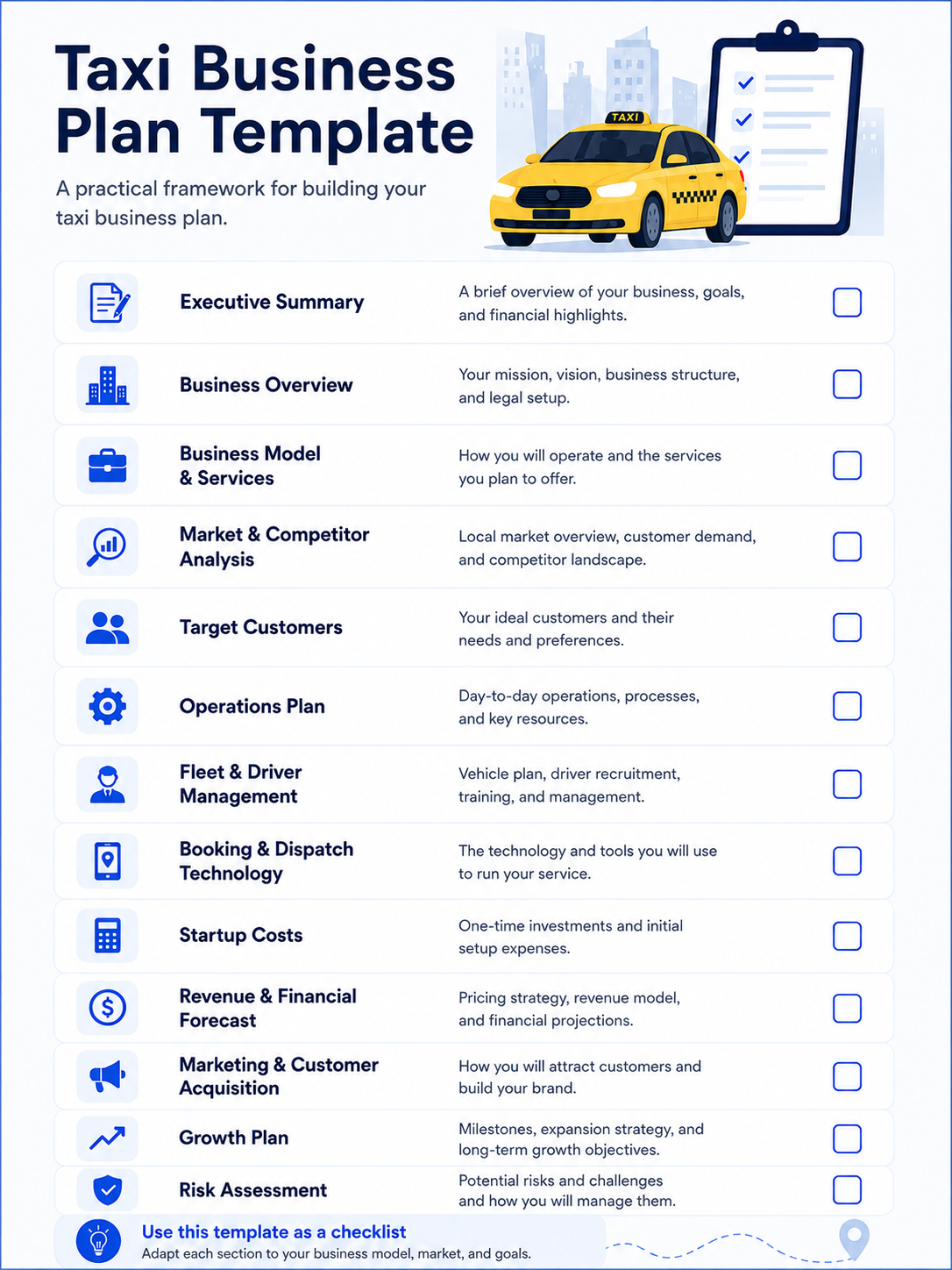
Taxi Business Plan Template
Now that you’ve planned each part of your business, it’s time to bring everything together into one document. Use the outline below as a starting point for creating your own taxi business plan. Depending on your business model and market, you can expand or simplify each section.
Final Thoughts
Building a successful taxi company starts long before your first ride. The planning process helps you test your assumptions, understand the financial viability of your idea, and identify potential challenges before they become costly mistakes. A well prepared plan for a taxi business gives you a clearer understanding of how every part of your business fits together, from your target market and pricing strategy to daily operations and long term growth.
No business plan will stay exactly the same as your company evolves, and it shouldn’t. As you gain experience, collect customer feedback, and analyze real business data, your plan should evolve alongside your business. The more regularly you revisit it, the easier it becomes to make informed decisions, adapt to market changes, and build a taxi company that’s prepared for sustainable growth.
F.A.Q.
Ready to revolutionize your taxi business?
Choose what you need: