
Open Source Taxi Dispatch Software: Costs, Control, and Complexity


Choosing software for a taxi business means deciding how much control, flexibility, and technical responsibility the company is ready to take on. Open source solutions can look particularly attractive at first: the source code is accessible, customization seems flexible, and the initial investment may appear lower. However, the real cost and effort required to turn open source code into a reliable operational system are not always obvious from the start.
In this article, we take a practical look at open source taxi software, from available projects and their capabilities to technical requirements, hidden costs, and operational limitations. We’ll also compare open source solutions with managed SaaS platforms to help you understand which approach makes more sense for your resources, growth plans, and day-to-day operations.
What Is Open Source Taxi Dispatch Software?
Open source taxi dispatch software is a taxi management system built on source code that is publicly available for use and modification. A taxi company can deploy the system on its chosen infrastructure, adapt its functionality to specific business needs, connect external services, and develop custom features. This gives businesses more freedom to shape the technology around their operations instead of working only within the functionality and configurations provided by a software vendor.
The scope of open source projects varies widely. Some focus on individual parts of taxi operations, such as dispatching, booking management, or driver coordination, while others combine several components, including ride assignment, trip tracking, fleet management, and mobile apps. However, access to source code does not automatically mean getting a complete, production-ready taxi platform. The actual capabilities and resources required depend heavily on the project.
How an Open Source Taxi Dispatch System Works
An open source project provides the codebase, but the business still needs to turn it into a working system. A technical team typically deploys the software, configures the infrastructure and core functionality, connects required third-party services, and adapts the system to the company’s operational model.
After launch, the technical work continues. The business or its development partner is responsible for hosting, monitoring, security, updates, bug fixes, and further improvements. If the company needs a payment gateway, local maps, specific pricing logic, or other functionality that the original project does not support, these integrations and features must be developed and maintained separately.
Who Should Consider an Open Source Solution?
Open source can make sense for taxi businesses with an experienced in-house technical team or reliable long-term development resources. It is particularly relevant when a company needs deep customization, wants direct control over its infrastructure and codebase, or has technical requirements that standard platforms cannot easily accommodate.
For smaller operators, startups, or companies without dedicated technical resources, the model requires more careful evaluation. The ability to access and modify the code has real value only when the business has the expertise and budget to deploy, maintain, and continuously develop the system. In these cases, the initial software cost is only one part of the decision; long-term technical workload and total cost of ownership matter just as much.
Best Open Source Taxi Dispatch Software Projects
The open source taxi software landscape is highly fragmented. Projects that appear under the same category can differ significantly in scope: one may provide a dispatch backend, another a passenger or driver app, while others focus on ride matching or broader fleet infrastructure. Fully developed, actively maintained open source systems built specifically for end-to-end taxi operations are relatively rare, while many available projects are experimental, educational, or limited to individual components.
Below, we’ve selected several projects that show how open source technology can be applied to different parts of taxi and fleet operations. We’ll briefly look at what each one is built for, its core functionality, and the role it can realistically play in an operational setup.
Ontaxi Taxiserver
Ontaxi Taxiserver is an open source dispatch solution designed to manage the flow of ride requests between dispatchers and drivers. It receives incoming orders from a dispatcher panel or external server, processes them, and distributes them to connected driver applications. This setup supports real-time order management and provides the core logic needed to connect the dispatch process with drivers in the field.
Businesses can use Ontaxi Taxiserver as the foundation for a dispatch environment tailored to their own operational model. The system can be configured and extended depending on specific workflows and technical requirements. Since the project focuses primarily on the server side of dispatch operations, companies looking for a broader taxi management setup can complement it with the necessary user-facing applications, integrations, infrastructure, and ongoing technical support.
OpenTaxi
OpenTaxi is an open source taxi application that provides a codebase for teams exploring their own taxi app development. The project can be used as a technical starting point for further customization and development around a specific service model.
Turning it into a system for daily taxi operations would require additional development and connection to the wider operational setup. Businesses considering this type of project should first evaluate the codebase, technical requirements, and the work needed to support their intended service.
Autofleet Locomotion
Autofleet Locomotion focuses on the passenger side of mobility services. The open source application provides the customer-facing booking experience for ride-hailing, ride-sharing, and other transportation models, with room for customization and connections to services such as maps and payment tools.
This makes Locomotion useful as part of a broader mobility technology setup rather than as the entire operational system. A taxi company that also needs dispatching, driver management, fleet control, or route optimization would need to connect the passenger app with the systems responsible for these processes.
Fleetbase
Fleetbase takes a broader approach than the other projects in this selection. It is an open source platform for fleet and logistics operations, offering tools for order management, routing, fleet coordination, and configurable operational workflows. Its modular structure gives development teams room to build additional functionality around different transportation use cases.
Because the platform was not designed exclusively for taxi and ride-hailing businesses, adapting it to this model requires a clear development plan. Passenger and driver experiences, taxi-specific booking flows, fare calculation, and other industry-specific processes would need to be added or integrated depending on how the service operates.
Open Source Taxi Apps vs. Complete Taxi Software
An open source taxi app is usually only one part of the technology needed to run a taxi or ride-hailing business. Even if a company uses separate passenger and driver apps, these applications alone are not enough to manage the service. The business also needs the operational layer behind them: a dispatch system to manage bookings and ride distribution, as well as administrative tools to control drivers, pricing, service areas, payments, and other parts of daily operations.
The challenge is that all these components need to work as one system. Bookings, driver availability, ride statuses, fares, and operational data have to move between customer-facing apps and the tools used by dispatchers and business teams. When separate open source components are involved, connecting them into a stable operational setup becomes a separate development task that requires integrations, infrastructure, testing, and ongoing technical maintenance.
Complete taxi software brings these parts together from the start. Instead of building the operational core around separate applications, a business gets a connected environment for serving passengers and drivers while managing dispatching and day-to-day operations. This reduces the technical work required to get the service running and makes it easier to manage changes as the business grows.
Mobion follows this model by bringing rider and driver experiences together with dispatch and business management tools in one connected system. Businesses can configure the setup around their operational model and focus on running and growing the service rather than building the connections between its core technology components.
Pros of Open Source Taxi Software
For companies with an in-house technical team or dedicated development resources, open source gives direct control over the development process. The team can modify workflows, build custom functionality, and decide which changes to prioritize based on current business needs. Development timelines, technical priorities, and resource allocation remain on the company’s side, which can be important for businesses with an established product vision and the capacity to manage software development internally.
Another advantage is direct control over infrastructure and data management. A company can choose where the system is hosted, configure the infrastructure according to its own requirements, and define how operational data is stored and managed. This can be particularly relevant for businesses with strict internal security policies, specific data residency requirements, or an existing technology infrastructure that the taxi software needs to fit into.
Cons of Open Source Taxi Dispatch Software
The main challenge with open source taxi software is the technical capacity and experience required to turn the code into a reliable system and keep it running over time. Before deployment even begins, the team needs to assess the quality and maturity of the project, understand its architecture and dependencies, and determine what additional components and integrations will be required for real operations. Deployment is only the beginning: the business also needs people who can configure the software, manage infrastructure and integrations, monitor performance, fix issues, apply security updates, and continue developing the system as operational needs change.
For smaller taxi companies and startups, maintaining this level of technical expertise can be difficult and expensive. Without an experienced in-house team, the business becomes dependent on external developers who need to understand the existing codebase and remain available when changes or urgent fixes are required. As the service grows, the technical workload can grow with it, making costs and development timelines harder to predict than they may appear at the start.
Hidden Costs of Free Taxi Software
The word “free” in open source software usually refers to access to the code, not to the cost of running the technology. A business may avoid a traditional software license fee, but turning the project into a working taxi system still requires development, infrastructure, testing, and ongoing maintenance. These costs are distributed across different areas and can be difficult to estimate before the system is actually deployed.
The table below shows where the main expenses typically appear:
| Area | What the business still needs to cover |
|---|---|
| Development | Initial setup, customization, integrations, and further feature development |
| Infrastructure | Hosting, cloud services, databases, monitoring, and scaling resources |
| Testing and QA | Testing new functionality, integrations, updates, and system stability |
| Maintenance and security | Bug fixes, dependency updates, security patches, and performance monitoring |
| Backups and recovery | Backup infrastructure, storage, and recovery processes |
| Technical support | Internal specialists or external developers available for troubleshooting and urgent issues |
The total cost depends heavily on the complexity of the project, the existing technical resources, and the scale of operations. For some companies, managing these areas internally is a deliberate choice. For others, especially smaller operators and new businesses, the combined cost of technical specialists, infrastructure, and ongoing maintenance can make a “free” solution less predictable than a managed software subscription.
Open Source Taxi Booking System vs. SaaS Platform
Choosing between an open source taxi booking system and a SaaS platform is largely a question of how a company wants to allocate its time, budget, and internal resources. With open source, technology becomes a separate area of investment: the business plans development priorities, allocates technical resources, and decides how the system evolves. This model can suit companies that want software development to remain an internal capability and have the expertise to manage it.
A SaaS model shifts the focus from building and managing technology to using it as part of the business. The company works with a functioning product, plans software costs more predictably, and can dedicate more attention to launching services, attracting drivers and passengers, improving operations, and entering new markets. The trade-off is less direct control over the product roadmap, although the level of configuration and customization varies between providers.
For a taxi business, the practical difference is not simply “free software versus paid software.” It is a choice between investing resources in managing the technology process and using a managed product that allows the team to focus primarily on operating and growing the service.
How to Evaluate an Open Source Taxi Project
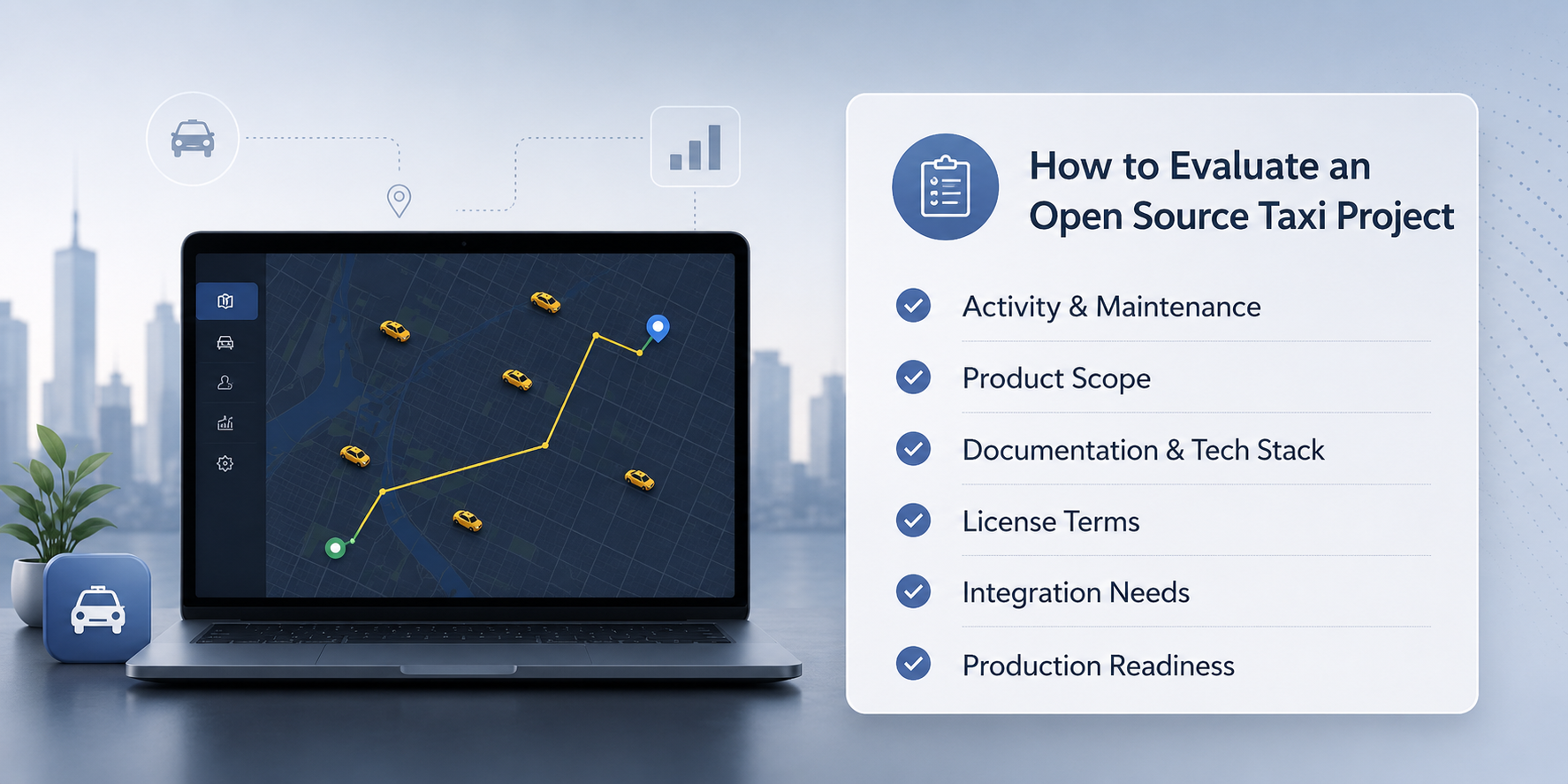
Before investing time and resources in an open source taxi project, it is important to evaluate more than its feature list. A project may look suitable at first glance but differ significantly in technical maturity, maintenance activity, documentation quality, and readiness for real-world operations. The following areas deserve particular attention:
- Project activity and maintenance. Check how recently the project has been updated, whether new releases are published, and how actively reported issues are addressed.
- Actual product scope. Determine whether the project covers a complete operational workflow or only a specific component, such as a passenger app, driver app, or dispatch backend.
- Documentation and technical stack. Review the available setup and development documentation and make sure your team has the expertise to work with the technologies used.
- License terms. Understand how the code can be modified, distributed, and used commercially before building business-critical functionality around it.
- Integration requirements. Identify which essential services, including maps, payments, communications, and analytics, need to be connected separately.
- Production readiness. Assess what additional work is required around security, performance, monitoring, backups, and scalability before the system can support real operations.
A technically interesting project is not necessarily a practical foundation for a taxi business. The final assessment should consider not only what the software can do today, but also the resources required to bring it into production and keep it reliable as the service grows.
Final Thoughts
For a taxi business, the value of open source software ultimately depends on what it takes to turn the technology into stable daily operations and support the service as it develops. Access to the code is only the starting point, while the real business impact depends on the resources, expertise, and ongoing work required to make the system perform reliably over time.
That is why an open source project should be evaluated as a long-term business investment rather than simply a software choice. The initial setup is only one part of the picture: the company needs to understand the resources the system will require over time and whether the expected benefits justify that investment. A well-informed decision starts with looking beyond the code and considering how the technology will support the business in practice.
F.A.Q.
Ready to revolutionize your taxi business?
Choose what you need: