
White Label vs Custom Taxi Software: A Practical Comparison

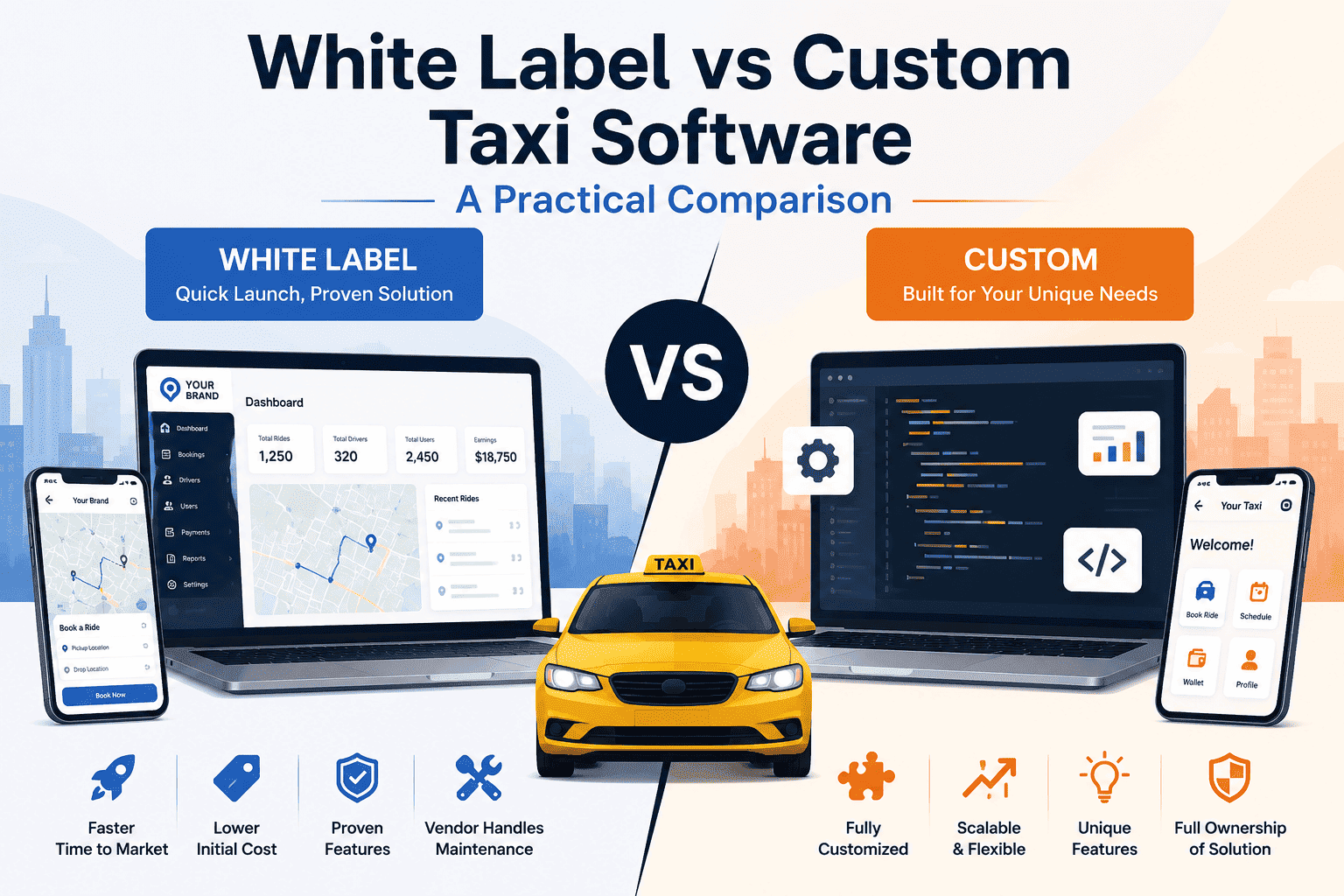
Choosing the technology behind your taxi business is one of the earliest decisions you'll make, and one of the hardest to change later. Both white label solutions and custom development can support long-term growth, but they differ significantly in cost, launch speed, flexibility, and ongoing maintenance. Understanding these trade-offs will help you choose the approach that best matches your business goals.
Whether you're launching a new service or replacing an existing system, the software you choose becomes the foundation of your ride-hailing and mobility platform. In this guide, we'll compare both approaches and explain when each one makes the most sense.
White Label vs Custom Taxi Software: Understanding the Difference
Choosing between a white label solution and custom taxi software is one of the biggest technology decisions a taxi operator will make. Both approaches can support dispatching, booking, payment processing, and fleet management, but they differ significantly in how they're built, deployed, maintained, and scaled over time.
A white label platform gives you access to ready-made software that can be branded and launched quickly with minimal development effort. A custom solution is built specifically for your business, allowing you to define every feature, workflow, and integration from the ground up. While that provides greater flexibility, it also requires a much larger investment of time, budget, and technical resources.
Neither approach is universally better. The right choice depends on your business stage, growth plans, available budget, and how much control you need over the product. In the following sections, we'll compare both options across the factors that matter most, from launch speed and costs to scalability, maintenance, and long-term ownership.
What Is White Label Taxi Software?
White label taxi software is a ready-made technology platform that taxi and ride-hailing companies can launch under their own brand without developing the product from scratch. The core technology already exists, while the operator configures the service for its market, adds its branding, defines pricing and operating rules, and decides how customers and drivers will interact with the service.
For a business, this changes the role technology plays in the launch. Instead of assembling a development team and spending months building booking, dispatch, payment, and fleet management functionality, the operator starts with a system that has already been developed and tested. A white label taxi app can therefore shorten the path from business idea to live operations while keeping the customer-facing product branded as the operator's own.
Modern software for taxi businesses can bring the main operational tools into one environment, so bookings, drivers, dispatching, payments, and business management do not have to rely on disconnected systems.
How White Label Taxi Software Works
A white label solution starts with an existing platform rather than a blank product. The provider maintains the underlying technology, while the taxi company configures the parts that define how its service operates.
During setup, operators typically add their branding, configure service areas and fares, create driver and vehicle rules, connect payment options, and prepare booking channels for customers. Rider and Driver Apps can then be released under the company's brand, while dispatchers and administrators work through the operational side of the platform.
Once the service is live, the software provider usually continues to maintain the infrastructure, release updates, fix technical issues, and develop the core product. The taxi company remains responsible for running the transportation business, while the technology layer is supported externally. This division of responsibility is one of the main differences between white label software and building a custom product internally.
What's Usually Included in a White Label Solution
White label software is usually designed as an operating system for the whole taxi service rather than a standalone passenger app. The exact scope depends on the provider, but the main components commonly cover the customer journey as well as day-to-day fleet operations.
A typical solution may include:
- Rider App for booking, payments, trip tracking, and ride history
- Driver App for receiving and managing ride requests
- Dispatcher Panel for monitoring and assigning bookings
- Admin Dashboard for managing users, drivers, vehicles, pricing, and business settings
- Online booking website for customers who prefer web bookings
- Automated dispatching and driver matching
- Fare calculation and payment processing
- Driver and fleet management tools
- Notifications and customer communication
- Reporting and operational analytics
The main advantage of having these components within one platform is not simply convenience. They are built to exchange the same booking, driver, customer, and payment data, which reduces the need to maintain several separate products and custom integrations as the operation grows.
Pros of White Label Taxi Software
For many operators, the strongest argument for white label software is that it removes a large part of the technical uncertainty from launching or modernizing a taxi business. The product already exists, the core workflows have been developed, and the company can invest its resources in operations, customer acquisition, and service quality rather than building infrastructure before the first ride is completed.
The main advantages include:
- Faster time to market compared with custom development
- Lower upfront technology investment
- Access to functionality that has already been developed and tested
- Ongoing maintenance and software updates handled by the provider
- Less need for an internal development and infrastructure team
- More predictable technology costs
- Ability to expand operations without rebuilding the entire product
This can be especially valuable when a business is still validating its market, launching in a new city, or scaling an existing fleet. At these stages, speed and operational reliability often have greater business value than owning every line of code.
Cons of White Label Taxi Software
The trade-off is that a ready-made platform does not provide unlimited freedom. Operators are working within an existing product architecture, which means some workflows, integrations, or customer experiences may need to fit the possibilities supported by the platform.
The most common limitations include:
- Less freedom to redesign core functionality from the ground up
- Dependence on the provider for major product changes and new features
- Highly specialized workflows may require adaptation
- Certain integrations may depend on the provider's technical capabilities
- Migration to another platform can require additional time and planning
- Subscription and usage costs continue throughout the relationship with the provider
These limitations matter most when technology itself is a major source of competitive differentiation. A company that needs highly specific functionality or intends to build a unique technology product may eventually require more control than a white label platform can offer. For many taxi operators, however, the decision comes down to whether that additional control is worth the higher development cost, longer launch timeline, and ongoing responsibility for maintaining the software.
What Is Custom Taxi App Development?
Custom taxi app development means building your taxi platform specifically for your business instead of adapting an existing product. Every major component, from the passenger experience and dispatch logic to driver workflows, integrations, and reporting, is designed around your operational requirements.
Unlike white-label solutions, a custom platform starts with your business goals rather than a predefined product. That gives you complete flexibility over how the software works, but it also requires significantly more time, budget, and technical resources to develop and maintain.
Many operators choose this approach when technology itself is expected to become a competitive advantage rather than simply a tool for running daily operations.
If you'd like to explore the development process in more detail, we've covered it in our guide to taxi booking app development.
What You Get with a Custom-Built Taxi App
A custom built taxi app can include virtually any functionality your business requires because every feature is designed specifically for your operations instead of fitting within an existing platform.
Typical capabilities include:
- Fully customized Rider and Driver Apps
- Proprietary dispatching algorithms
- Custom pricing and commission models
- Unique booking flows and customer journeys
- Integrations with internal business systems
- Advanced reporting and business intelligence
- Custom APIs and third-party integrations
- Multi-country or multi-brand architecture
- Features developed specifically for your operational model
The biggest advantage isn't the number of features but the freedom to decide exactly how the platform should evolve. As your business grows, the software can be expanded around your strategy instead of waiting for a vendor's product roadmap.
Pros and Cons of Custom Taxi App Development
Choosing custom taxi app development gives you maximum flexibility, but it also means taking full responsibility for building, maintaining, and evolving the platform. Unlike a white-label solution, there is no existing product roadmap or infrastructure to rely on. Every feature, integration, update, and improvement must be planned, developed, tested, and supported over the long term. Whether this approach makes sense depends on your budget, technical resources, and long-term business strategy
| Pros | Cons |
|---|---|
| Complete ownership of the platform and source code | Higher upfront investment |
| Unlimited customization and branding flexibility | Longer development and time to market |
| Full control over the product roadmap and feature priorities | Ongoing maintenance, infrastructure, and hosting costs |
| Easy integration with proprietary systems and third-party services | Requires an experienced development team or reliable technology partner |
| Ability to build unique features that differentiate your business | Greater responsibility for security, updates, and regulatory compliance |
| No dependency on a software vendor's pricing or release schedule | Higher project risk if requirements, timelines, or budgets change |
For companies building a technology-first business with unique operational requirements, custom development can become a valuable long-term investment. However, many taxi operators discover that the additional flexibility comes with significantly higher costs and complexity than they initially expected. That's why it's important to evaluate both the business case and the total cost of ownership before deciding which approach is the better fit.
White Label vs Custom Taxi Software: Comparison Table
Both approaches can help you launch and grow a taxi business, but they solve different problems. A white-label solution focuses on getting your business to market quickly with proven functionality and predictable costs. A custom platform prioritizes flexibility, ownership, and the ability to build software around unique business requirements.
The right choice depends on your priorities, available resources, and long-term growth strategy. The comparison below highlights the key differences across the factors that matter most when selecting taxi software.
White Label vs Custom Taxi Software Comparison
| White Label Taxi Software | Custom Taxi Software | |
|---|---|---|
| Initial cost | Lower upfront investment with predictable pricing | High upfront development costs |
| Time to market | Launch in weeks | Typically several months or longer |
| Customization | Configuration and branding within the existing platform | Unlimited customization and feature development |
| Scalability | Easily scales with business growth | Scales based on system architecture and ongoing development |
| Maintenance | Managed by the software provider | Managed by your internal team or development partner |
| Technical support | Included as part of the service | Depends on your development resources |
| Ownership and control | License to use the platform | Full ownership of the software and source code |
| Risk level | Lower implementation and operational risk | Higher project and technical risk |
| Best fit | Companies that want to launch quickly and reduce development costs | Businesses with unique operational requirements and long-term technology strategies |
The comparison provides a high-level overview, but every factor affects your business differently. Let's look at each of them in more detail.
White Label vs Custom: The Full Breakdown
The comparison table gives a quick overview, but choosing between white label and custom software usually comes down to a handful of practical questions. Budget, launch timeline, future growth plans, and available technical resources all influence which option creates more value for your business. Let's look at each factor in more detail.
Cost and Total Investment
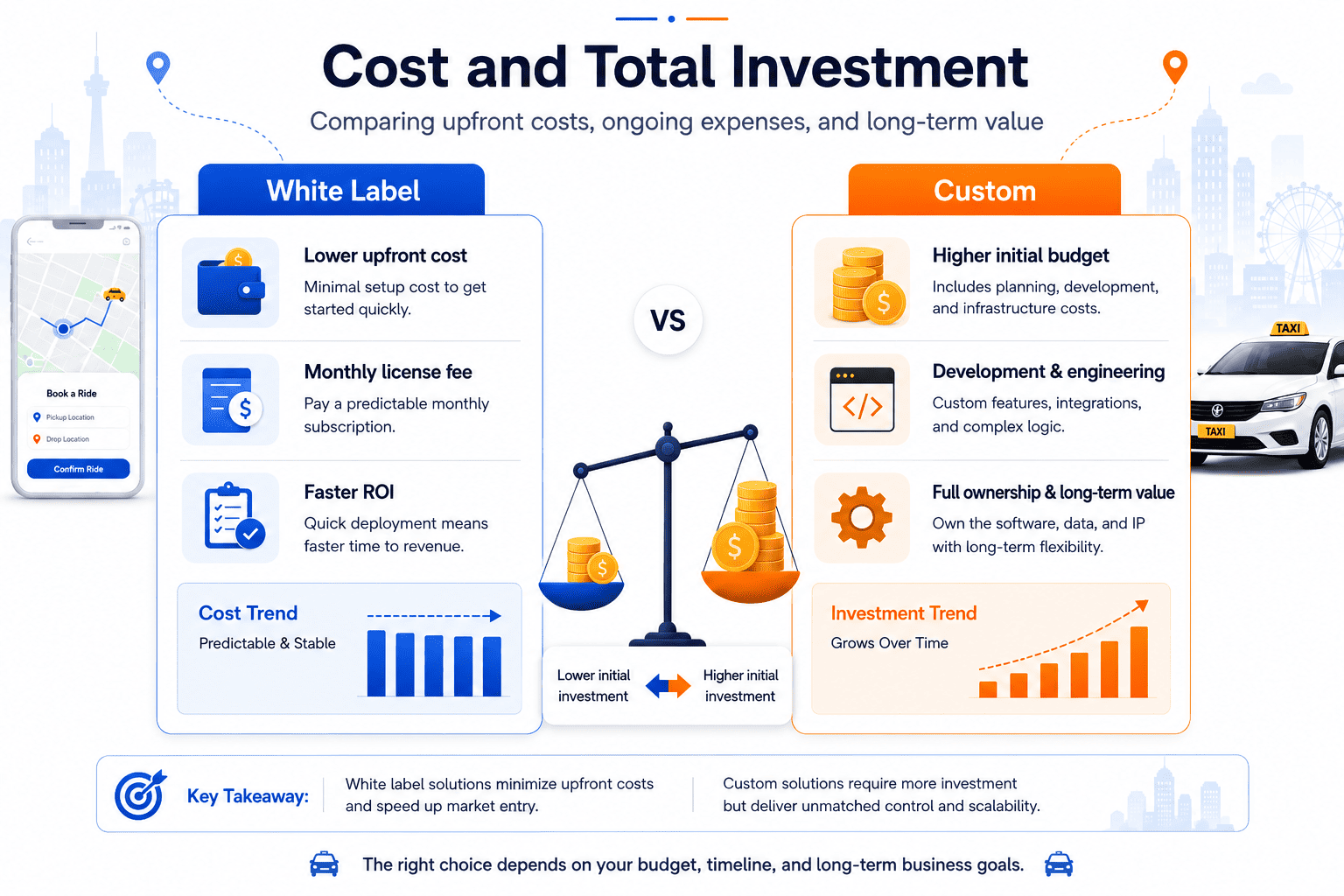
Custom development typically requires a significant upfront investment before the first customer can even book a ride. Beyond development, you'll also need to budget for infrastructure, maintenance, security, testing, and future feature updates.
A white-label solution spreads those costs over time. Instead of investing heavily before launch, operators can start with a predictable subscription or licensing model while using a platform that has already been tested in real business environments. For many growing taxi companies, this reduces financial risk and allows capital to be invested in marketing, fleet expansion, or customer acquisition instead.
Time to Market
Building a custom platform often takes several months and sometimes more than a year, depending on project complexity. During that time, requirements can change, development priorities shift, and market opportunities may be missed.
White-label software allows operators to launch much faster because the core platform already exists. Branding, configuration, and operational setup can usually be completed in a fraction of the time, allowing businesses to begin serving customers and generating revenue much sooner.
Customization and Branding Flexibility
Custom software offers virtually unlimited flexibility. Every workflow, feature, and user experience can be designed specifically around your business model.
White-label platforms naturally work within an existing product framework, but modern solutions still allow extensive branding, pricing configuration, dispatch settings, service types, payment integrations, and operational customization. For many operators, these options cover the vast majority of day-to-day business needs without the complexity of building software from scratch.
Scalability for Growth
As your business grows, your software needs to grow with it. Both approaches
can support expansion, but they do so differently.
Custom platforms scale through continuous development, meaning new markets,
services, or features often require additional engineering work. White-label
platforms are designed to support business growth from the start, allowing
operators to add drivers, vehicles, dispatchers, and locations without
rebuilding the core system.
Maintenance, Updates, and Support
Launching software is only the beginning. Every platform requires ongoing
updates, security patches, infrastructure management, bug fixes, and
compatibility improvements.
With custom software, those responsibilities remain with your internal team
or development partner. White-label providers handle these tasks as part of
the service, allowing operators to spend less time managing technology and
more time running their business.
Security and Reliability
Security becomes increasingly important as your business handles customer
data, payments, and operational information.
A custom platform gives you complete control over security architecture, but
it also means you're responsible for monitoring vulnerabilities, applying
updates, and maintaining compliance. White-label platforms benefit from
continuous maintenance across multiple customers, with security improvements
and stability updates typically delivered as part of the product lifecycle.
Operational Complexity for Taxi Business Owners
Perhaps the biggest difference isn't technical at all. It's operational.
Custom software often requires active involvement in product planning,
feature prioritization, testing, and long-term technical decision-making. A
white-label platform removes much of that complexity by providing proven
functionality out of the box, allowing operators to focus on growing the
business rather than managing software development.
When White Label Taxi Software Is the Better Choice
Choosing between white-label and custom software isn't only about technology. It's about selecting the approach that best matches your current stage of business, available budget, and long-term goals. While custom development offers maximum flexibility, many taxi operators don't need to build a platform from scratch to launch a successful business. In practice, white-label software is often the more practical choice because it reduces implementation risk, shortens the time to market, and allows operators to focus on growing their business instead of managing software development.
You Want to Launch Fast
Launching quickly is one of the biggest advantages of choosing a white-label solution. Because the core platform has already been developed and tested, implementation focuses on branding, configuration, and operational setup rather than months of software development. This allows operators to start accepting bookings sooner, generate revenue earlier, and respond to market opportunities without lengthy development cycles.
You Want Lower Upfront Costs
For many taxi businesses, keeping the initial investment under control is just as important as choosing the right technology. A white-label platform significantly reduces the capital required to launch because there is no need to fund a complete software development project before the business becomes operational. Instead, more of your budget can be invested in marketing, driver recruitment, fleet expansion, and customer acquisition—areas that have a direct impact on business growth.
You Need Proven Software for Taxi Business Operations
Daily taxi operations depend on multiple systems working together seamlessly, including booking management, dispatching, payments, driver communication, reporting, and customer support. Choosing a platform that has already been proven in real operating environments reduces implementation risk and gives operators confidence that the software is ready for day-to-day business. Rather than solving technical challenges, you can concentrate on delivering reliable service and growing your company.
You Want to Validate Demand Before Scaling
Testing a new market or business model becomes much less risky when you don't have to invest heavily in software before launching. A white-label platform allows you to validate demand, build a customer base, and understand how your operations evolve before deciding whether additional custom functionality is actually needed. That approach ensures future technology investments are based on real business needs rather than assumptions.
If you're looking for a white-label solution that combines fast deployment with the flexibility to grow over time, Mobion provides everything needed to launch and manage a modern taxi business. The platform includes branded Rider and Driver Apps, a booking website, dispatcher and admin panels, automated dispatching, payment processing, and the operational tools required to run your business efficiently. As your company grows, the platform can evolve with you through additional integrations, new features, and custom functionality when your business is ready for the next stage.
When Custom Taxi App Development Makes Sense
Building a custom taxi platform is a much larger investment than using an existing solution, but for some businesses it becomes the right long term strategy. The decision is usually driven by the need to support unique business processes, create proprietary functionality, or build technology that becomes part of the company's competitive advantage rather than simply managing day to day operations.
Custom development is typically the right choice when standard platforms no longer meet your operational requirements. That may include highly specialized dispatch workflows, complex third party integrations, proprietary pricing models, advanced automation, or features designed specifically for your business instead of the broader taxi market. In these situations, complete control over the product can justify the higher investment and longer development timeline.
Another important consideration is long term ownership. With a custom platform, you decide how the product evolves, which features are prioritized, and how quickly new functionality is released. That level of flexibility can be valuable for companies with ambitious product roadmaps or highly specialized operational requirements.
At the same time, custom software requires an ongoing commitment beyond the initial development phase. Maintenance, infrastructure, security updates, testing, and continuous improvements all become part of the total cost of ownership. Businesses that choose this path should be prepared to invest not only in building the platform but also in supporting and evolving it for years to come.
The Hybrid Approach: Start White Label, Scale with Custom Features
Choosing between white-label software and custom development doesn't always have to be an either-or decision. Many successful taxi businesses follow a hybrid approach. They launch with a proven platform, start serving customers, validate their business model, and only invest in custom development once they have a clear understanding of which additional features will create real value.
This approach allows operators to enter the market faster, reduce upfront investment, and avoid spending months building functionality that may never be used. Instead, they can focus on growing the business while collecting real operational data and customer feedback.
As the company grows, new requirements naturally emerge. Additional integrations, workflow automation, or proprietary features can be introduced gradually, based on real business needs rather than assumptions made before launch. This significantly reduces risk while ensuring every technology investment supports measurable business growth.
For many taxi operators, a hybrid strategy offers the best of both worlds. It combines the speed and reliability of an established platform with the flexibility to introduce custom functionality over time, allowing the software to evolve alongside the business instead of holding it back.
How to Choose the Right Taxi Software for Your Business
There isn't a single solution that's right for every taxi company. The best choice depends on your business stage, available budget, growth plans, and operational requirements. Before making a decision, focus less on individual features and more on the long-term value the platform will provide as your business evolves.
Ask yourself a few practical questions:
- How quickly do you need to launch?
- What budget can you realistically invest today?
- Which features are essential now, and which can wait until later?
- Will your software support future growth without requiring a complete replacement?
- Do you have the technical resources to maintain a custom platform over the long term?
The answers will usually make the right direction much clearer. A business focused on launching quickly and validating demand often benefits from a white-label solution, while companies with highly specialized operational requirements may eventually justify investing in custom development.
Regardless of which path you choose, your booking experience will play a major role in customer satisfaction and operational efficiency. A modern taxi website booking system should make it easy for passengers to request rides, complete payments, and stay informed throughout the journey while giving operators full control over bookings and dispatching.
Conclusion
The software you choose today will influence much more than how customers book rides. It will shape your daily operations, determine how efficiently you can scale, and affect the long-term cost of growing your business.
For most operators, white label taxi software offers the fastest and most practical path to market. It reduces upfront investment, shortens implementation time, and provides the essential tools needed to launch and grow without waiting months for a custom-built platform.
Custom development becomes the stronger choice once your business has matured and your operational requirements extend beyond what existing platforms can provide. At that stage, investing in proprietary technology can create additional value and support your long-term strategy.
The most effective approach is to choose a solution that fits your business today while leaving room for future growth. Technology should help you serve customers more efficiently, simplify operations, and support sustainable expansion instead of becoming an obstacle to it.
F.A.Q.
Ready to revolutionize your taxi business?
Choose what you need: