
How to Start a Taxi Business With One Car: A Practical Guide


Starting a taxi business does not have to mean buying several vehicles, hiring drivers, and building a full operation from day one. For many people, the first step is much smaller: one car, one driver, and a plan to turn individual taxi work into a business they can control and eventually grow.
This is especially relevant if you already drive professionally or own a suitable vehicle. The challenge is no longer simply finding passengers and completing rides. You need to understand whether the numbers work, how to attract bookings independently, what licenses and insurance you need, which technology is worth paying for at this stage, and when it makes sense to expand beyond one vehicle.
Starting small can actually make those decisions easier. With lower initial costs and a simpler operation, you can test demand, understand your real margins, and build a customer base before committing more money to the business.
The same fundamentals that apply when starting a taxi business still matter, but with one car, every investment and operating decision has a much more immediate impact.
In this guide, we will focus specifically on building a one car operation, from choosing how you will work and calculating startup costs to managing bookings, meeting local requirements, and creating a foundation for future growth.
Starting a Taxi Business With One Car: Is It a Viable Model?
Starting with a single vehicle is not simply a smaller version of running a taxi fleet. It is a different business model with lower financial risk, fewer operational layers, and much more direct control over how the business works.
A one car taxi business can be a practical way to enter the market without committing to several vehicles or a team of drivers from the beginning. One vehicle is enough to test local demand, understand which customers and routes are most profitable, build a base of repeat passengers, and learn what it actually costs to complete each ride. If the numbers work, expansion can come later.
The first major decision is whether you will drive the car yourself or treat it as a business asset and hire someone to operate it.
Owner Driver vs. Hiring a Driver
For most first time operators, driving the vehicle themselves keeps the model simpler. There is no driver salary to cover, and the owner sees directly how demand, pricing, working hours, and operating costs affect profitability. Hiring a driver creates more flexibility, but it also introduces another major expense and requires the business to generate enough revenue to support both the vehicle and the person operating it.
| Owner Driver | Hiring a Driver | |
|---|---|---|
| Startup costs | Lower, with no immediate recruitment or payroll costs | Higher due to hiring, onboarding, and employment related costs |
| Control | Direct control over service, schedule, and vehicle use | Requires clear processes and oversight |
| Workload | Owner handles both driving and business management | Owner can focus more on managing and developing the business |
| Operating costs | Lower because there is no separate driver wage | Driver compensation becomes a significant recurring expense |
| Profit potential | More revenue can remain with the owner, but income depends on personal driving capacity | Potential to separate ownership from daily driving, provided ride volume supports the additional cost |
For someone testing the market with one vehicle, the owner driver model is usually the leaner starting point. Hiring becomes more attractive once demand is consistent enough that the car could generate revenue beyond the hours the owner wants or is able to drive.
What Do You Actually Need to Start With One Car?
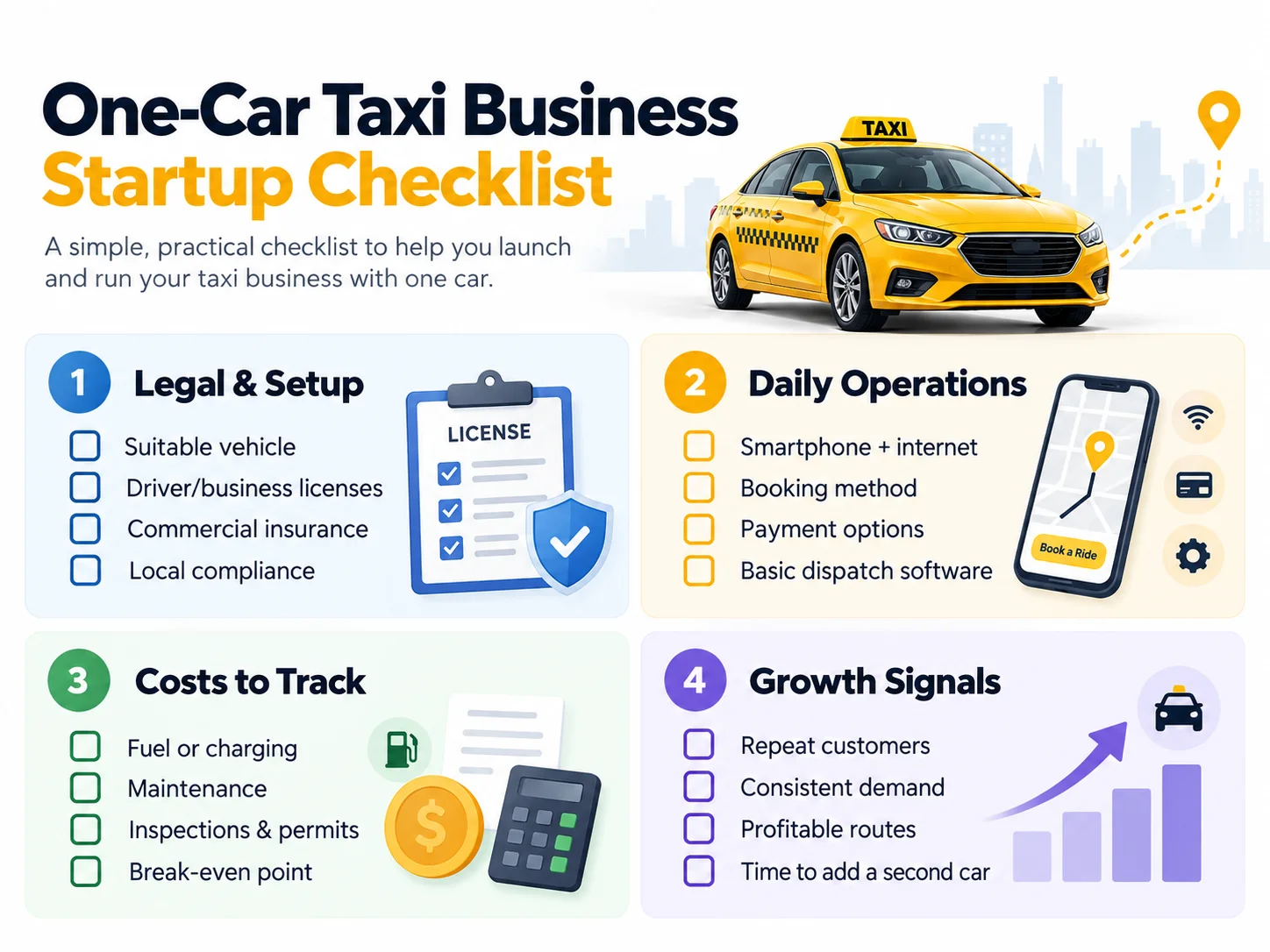
A one car operation does not require the infrastructure of an established taxi company. The goal at this stage is to build a minimum viable setup that allows you to accept bookings legally, complete rides reliably, receive payments, and keep the day to day operation manageable.
At the most basic level, that means having a suitable and properly insured vehicle, meeting the licensing requirements in your market, having a smartphone with reliable mobile internet, and giving passengers a clear way to book and pay for rides. You also need a simple system for keeping track of bookings rather than relying entirely on calls, messages, or personal notes as demand begins to grow.
The exact legal requirements vary by country and city, but the operational principle is much more universal: start with what you need to deliver a professional service today and add complexity only when the business actually requires it.
Essential Requirements
The one car taxi business requirements are relatively straightforward compared with those of a larger fleet. Your initial setup will typically include:
- A suitable vehicle that meets local taxi or private hire standards
- The required driver and business licenses or permits
- Commercial or taxi insurance appropriate for passenger transport
- A smartphone with reliable mobile connectivity
- A way for customers to book rides
- A payment method that works for your target customers
- Basic software for organizing bookings and managing daily operations
The important distinction is between what is essential for completing your first rides professionally and what might become useful later. That can prevent a significant amount of unnecessary spending before you know how much demand the business can generate.
What You Don’t Need When Starting With One Car
Starting a taxi business does not mean recreating the infrastructure of a large fleet on a smaller scale. With one vehicle, you do not need an office, a dedicated dispatcher, multiple management roles, or complex fleet management processes. You also do not need to invest in custom software or build your own passenger and driver applications before taking the first booking.
Keeping the operation lean gives you room to learn. You can see how customers prefer to book, which hours generate demand, what your real operating costs look like, and where manual work actually becomes a problem. Investments should follow those needs rather than come before them.
For a one car business, the objective is not to build everything you might need in three years. It is to create a professional setup that works for one vehicle today and can expand when the business gives you a reason to do so.
How Much Does It Cost to Start a Taxi Business With One Car?
The cost to start a taxi business with one car can vary dramatically depending on one decision: whether you already own a suitable vehicle. For a small operation, the car is usually the largest investment, while most other startup costs come from licensing, insurance, registration, technology, and preparing the vehicle for commercial use.
This is also where starting with one car has a clear advantage. You do not need to invest in the infrastructure of a larger taxi company before you have generated your first revenue. Some technology providers have entry level plans designed specifically for this stage. Mobion Starter, for example, allows a new taxi business to launch with its own booking page, Driver App, and admin tools and use the platform for free for up to 2,000 completed rides. That keeps one of the typical technology costs low while the business is still testing demand and building its customer base.
Starting With a Car You Already Own
If your existing vehicle meets local requirements for commercial passenger transport, your initial investment can be relatively limited. Instead of financing or purchasing a car, you can focus on the costs required to make it operational as a taxi: commercial insurance, licenses and permits, inspections where required, and any necessary vehicle preparation.
Owning the car does not make the vehicle itself free, however. Depreciation, maintenance, tires, fuel or charging, cleaning, and repairs should all be included when calculating whether the business is financially viable. These costs may not appear on the day you launch, but they directly affect the margin you make from every ride.
Buying a Car for Taxi Work
Buying a vehicle specifically for the business increases the financial commitment considerably, so the decision should be based on expected revenue rather than simply on which car you would prefer to drive. Purchase price or monthly financing payments are only part of the calculation. Fuel efficiency, insurance, maintenance costs, reliability, depreciation, and local vehicle requirements can have a much larger impact over several years of intensive use.
For a first vehicle, the most useful car is not necessarily the newest or most premium option. It is one that meets passenger expectations and local regulations while keeping the cost of every working kilometer at a level the business can realistically support.
Create a Simple Business Plan for One Car
A business plan for a single vehicle does not need dozens of pages or complex financial projections. At this stage, its purpose is much more practical: to determine who will book your rides, how much revenue the car can realistically generate, what it costs to keep it on the road, and how many paid trips you need before the operation starts making money.
A useful one car taxi business plan should be built around numbers you can actually test and update. Estimate your average fare, expected rides per day, working days per month, and recurring operating costs. Then compare those assumptions with real results once you start taking bookings. For a small business, this makes the plan a working tool rather than a document you create once and never use again.
Define Your Target Customers
Trying to serve everyone can make it harder to build consistent demand, especially when you have only one vehicle available. Think about where repeat bookings could realistically come from in your market. That might be airport transfers, local residents, business travelers, hotel guests, elderly passengers, scheduled rides, or customers who need reliable transportation at specific times.
Your target customer also influences how you operate. Airport passengers may value advance booking and flight related reliability, while local customers may care more about availability and an easy way to book again. With one car, choosing the right type of demand can be more valuable than simply trying to maximize the number of individual ride requests.
Calculate Your Break Even Point
Before focusing on profit, calculate how much the vehicle needs to earn simply to cover the business. Add your fixed monthly costs such as insurance, financing, licenses, software, and other recurring expenses, then estimate variable costs such as fuel, maintenance, and payment fees.
From there, calculate how many rides you need at your expected average fare to cover those costs. If the business needs an unrealistic number of trips just to break even, you can adjust pricing, working hours, costs, or your target market before investing further.
The break even point will also change as the business develops. Tracking it regularly gives you a much clearer picture of whether higher booking volumes are actually producing more profit rather than simply creating more work.
Licenses, Insurance, and Local Requirements
A taxi business can be operationally simple with one car, but it still has to meet the same legal standards that apply to commercial passenger transport in its market. Before accepting paid rides, check the taxi license requirements for both the driver and the vehicle in the city or region where you plan to operate.
Depending on the location, this may include a taxi or private hire driver license, business registration, vehicle authorization, commercial passenger insurance, inspections, background checks, or specific rules for displaying license information. Some markets also regulate fares, vehicle age, accessibility, or where taxis are allowed to pick up passengers.
Insurance deserves particular attention. A standard personal auto policy will generally not provide the same coverage as insurance intended for carrying paying passengers. The appropriate policy and level of coverage should therefore be confirmed before the vehicle starts operating commercially.
Requirements can differ significantly even between cities in the same country, so there is no universal checklist that works everywhere. Treat licensing and insurance as part of the initial setup rather than something to resolve after bookings begin. This protects the business and also prevents regulatory issues from interrupting operations once you have started building a customer base.
Conclusion
Starting with one car is not a limitation that needs to be overcome as quickly as possible. It can be a practical way to build a taxi business with lower financial risk, understand the market firsthand, and make decisions based on real demand rather than assumptions.
At this stage, the priorities are relatively simple. The vehicle needs to be suitable and properly licensed, the operating costs need to make sense against expected revenue, and passengers need a reliable way to find and book the service. Keeping the setup lean also gives the owner time to understand which customers are worth focusing on, which working hours are productive, and how many rides are actually needed to make the business profitable.
Growth should come after those fundamentals are working. A second vehicle, hired drivers, additional technology, and more complex operations make sense when existing demand begins to justify them, not simply because they are associated with running a larger taxi company.
A one car taxi business therefore does not need to look like a fleet from day one. The stronger starting point is an operation that works efficiently at its current size, generates sustainable margins, and has a clear path to expand when the market provides the opportunity.
F.A.Q.
Ready to revolutionize your taxi business?
Choose what you need: